Showing posts with label struggles. Show all posts

Wednesday, October 5, 2022

30 Things You Learn in 18 Years of Parenting

I've done it. I've sent my first child to college.

That means I've successfully kept alive, fed, and clothed a whole other human for 18 years. This is huge for me, as I can't even handle houseplants.

And just like I've done a few posts musing on the things I've learned after 10 years and 15 years of parenting, this seems like a good milestone year to write another chapter.

If Phillip and I look tired in this picture, it's because we are.

1. Never judge anyone's parenting whose kids are older than yours. You have no idea.

2. People will say you'll have more free time once your kids reach [insert stage of life here]. They're lying.

3. Big kids are every bit as messy as little ones. Actually, they're worse, because you can't even begin nagging them to clean up until after their 3,000 extra-curricular activities.

4. Kids will forget almost all the things you did with them when they were younger, but they'll remember your family traditions with a Norman Rockwell-like nostalgia.

5. Wait as long as you possibly can before giving your kids smartphones.

6. If you don't specifically ask them to take care of the the toilet paper tube on the bathroom counter, they'll just adapt and it becomes a permanent fixture of the house.

This is our overflowing cardboard recycling bin. And it's overflowing because a child flattened a cardboard box, laid it on top of the empty bin, and piled everything else on top of it for a week.

7. It's really humbling when your kids get old enough to realize you're not perfect.

8. Occasionally asking your children to make sacrifices or go without something they want is nothing to feel guilty about. In fact, it's critical to their well-being.

9. Sharing your favorite shows and movies with your kids when they're old enough is magical. 

10. Even the best teenagers are super-frustrating sometimes.

11. The car is a great place to initiate serious talks with your older kids: you don't have to make eye contact, and they can't escape.

12. Eventually, kids will choose their own interests and preferences. They're usually not what you would've chosen for them, and this is surprisingly hard.

One of our children decided her passion was horseback riding; we later discovered she was allergic to horses.

13. When teenagers inconvenience you by throwing things together at the last minute, it isn't because they're inconsiderate. They genuinely don't realize that everyone else in the whole world (except other teenagers) plans ahead.

14. Frankly, it doesn't matter very much what your style of parenting is, as long as it communicates to your kids that you love them.

15. Making a perfectly reasonable request in your calmest and most pleasant demeanor can still be interpreted by your child as "yelling at them."

16a. The saying "little kids, little problems; big kids, big problems" is absolutely true. 

16b. When you're the parent dealing with your big kid's big problems, you desperately need support that you're unable to get because it would breech your teen's privacy. Sorry. 

17. Appreciate the years when your kid goes to bed early and you're off-duty at 8 PM every night.

18. Be home for your big kids as much as possible. Even when they don't depend on you for their minute-to-minute physical survival anymore, they thrive on the stability of your presence. 

19. Kids love few things more than they love leaving every light in the house on.

20. When giving your older child guidance, never end a sentence with a period. Just ask questions until they arrive at the conclusion you hoped they'd reach, and hopefully they'll take their own advice.

21. Teach your kids life skills. For one thing, they actually start being helpful when they're older, and for another, they'll be ready to leave home one day without being overwhelmed by adulting.

Eight years later, this is finally paying off.

22. You will, because of your older kids' large statures and self-assured attitudes, forget that they're still just kids. But don't worry, they'll do something to remind you soon enough.

23. People aren't exaggerating when they say teenage boys smell and will eat everything in sight. If anything, they're understating it.

24. Moodiness is normal, but if you honestly think your teen dislikes you or is chronically disrespectful to your face, your relationship needs help. (Here's a fantastic book about that.)

25. It's really irritating to be the driver for someone who has earbuds shoved in their ears.

26. Older kids refuse to sleep with a flat sheet. No one knows why.

Younger ones will choose to sleep on the floor in between the wall and the perfectly serviceable bed you bought them.

27. Potty training a toddler is a carefree frolic through the meadow compared to teaching a teenager to drive.

28. Everyone starts out thinking they'll be a chill parent, but sooner or later, they'll be threatening to burn down the house if they find one more empty box in the pantry like the rest of us.

29. It doesn't matter what's in the fridge, your kids will look in it and declare that there's "no food." And then they'll leave the door open.

30. Parenting is easier if you don't take yourself too seriously.

The thing that becomes clearest as you raise a child to young adulthood is that actually, you know nothing. Just do the best you can and never stop trying. With any luck, one day you'll have grandchildren to enjoy while your kids go gray trying to figure this stuff out for themselves.

Click to Share:
Unremarkable Files
Read More »

Wednesday, April 20, 2022

Becoming a Part-Time Empty Nester

"So you're a part-time empty nester now!" my friend Bridget joked on my youngest child's first day of kindergarten.

I laughed and told her I was surprised with how uneventful the transition was. When my son climbed on the bus on that first morning, I waved goodbye and skipped back into the house to work on my million mile long to-do list and didn't have any qualms about it. 

Everything seemed strangely fine. I seemed fine.


A few weeks later another friend asked how I was handling having all my babies in school, and when my eyes started leaking in the middle of my answer (weird!) I realized I wasn't as fine as I thought.

It's not that I don't love the morning quiet. Cleaning up the house in the morning and knowing it will stay that way for six hours is nothing short of amazing. And it isn't like my little boy has even left me yet: he still cuddles with me and laughs at my corny jokes after school like he did before. 

But still, I felt a profound loss I couldn't quite name. I finally figured it out weeks later, in line at the grocery store watching an exhausted young mom with a cart full of Gerber puffs playing peek-a-boo with her 9-month-old.

I'd been standing there staring off into space, but not her. She could fill every spare second  in fact, she had to fill every spare second  connecting with the little person who mattered most in the world. 

When you have little ones at your side all the time, you don't have to go looking for moments like that one in line at the grocery store, they find you. They're relentless at finding you. They find you in the middle of the night, they paw at you while you make dinner, they pound on the bathroom door shrieking until you let them in. It's overwhelming, because that's what motherhood is: too much of a good thing.

And for the first time in my career as a mom, I don't have access to those moments 24/7. It was once inconceivable to me that meaningful connection with my kids would require effort and planning. But here we are, squeezing it in between school and their various sports and activities.

When my kids were still little, I thought women who raved about their kids growing older were lying to themselves. They'd say how great it was not to mop up spilled milk at the dinner table and finally decorate the bottom third of the Christmas tree (with breakable ornaments, even!) and I'd think, So what? That's a sad consolation prize.

Now that I'm in their place, doing the same thing, I realize I was only half-right. Given the choice between a solo trip to the bathroom and the unconditional love and affection of a toddler, I'd choose the toddler every time. It's no contest.

But I don't get to make that choice, and it's not a contest anyway. Those older moms were just choosing to find the good in their current stage of life, whatever it was.

If I'm going to thrive in, and maybe even enjoy, my new life as a part-time empty nester, I'm going to need to celebrate the good things about where I am right now.

It doesn't come naturally to me, delighting in a life that isn't filled from sunup to sundown with hugs and kisses from a sticky 3-year-old. The joys, as well as the hard parts, of raising big kids are different.

Moms wrangling toddlers in Target, if I look a little too long or smile a little too hard when you pass by, please forgive me. I remember so fondly the place you're in right now and always will. But now it's time to move from living those days to smiling at photographs of them as the kids and I plan our next adventure together.

Click to Share:
Unremarkable Files
Read More »

Tuesday, July 20, 2021

Extreme Decluttering 101: Everything I Learned From Tackling My Messy House

Confession: I've always liked throwing stuff away, and I've always been quick to get rid of stuff that served no purpose. At least I thought I was.

But this spring I discovered a YouTuber called The Minimal Mom and long story short, ended up getting rid of 50% of our belongings. 

During an intense two months of attic-to-basement decluttering, here are some invaluable lessons I learned about figuring out how to live with less.


1. Invest in a "Maybe" Bin


When I first embarked on my decluttering journey, I kept the things I couldn't live without and put everything else in a temporary "maybe" bin. I was really aggressive about putting things in the "maybe" bin because nothing was permanent: if I regretted not having something, I could always take it back out and forget it ever happened.

I planned to keep things in the bin for 6 months as a test run of minimalism, but I was surprised to find that most of the time it only took about 10 minutes. The act of physically separating an item from the collection of "my stuff," then stepping back to look at my decluttered closet/shelf/cupboard and seeing that I still felt good about it, made letting go of things shockingly easy. 

After decluttering the entire house and garage from top to bottom, I think I ultimately took about five things back out of the "maybe" bin.

2. Consider a Tattoo that Says "Do I Use This?"


I'd done my fair share of decluttering before, but now that I was serious about it I approached each item we owned with the question "Do we use this?" instead of "Could we use this?" (It's super-important to note that these are two completely different questions.)

Honestly answering the question "Do we use this?" helped me part with items I've kept for years but could've been stolen by a burglar in the night and I most likely never would've known the difference.

If I got stuck on any item, I'd ask a follow-up question: "Would my life be any different without this?" It helped to acknowledge that getting rid of many things wouldn't negatively impact my life, it would only make the house less cluttered and easier to clean.

3. If You Won't Regret It, Get Rid of It


I encountered plenty of items that passed the "do we use this?" test, but I still got rid of them because they weren't adding very much value to my life. These two questions helped me identify those items:
  • "Will I miss this?" 
  • "What would happen if this item was gone?"


"Will I miss this?" helped me part with clothes I still wore but didn't particularly like. If I had other clothes I liked better, was I ever going to regret getting rid of that cream-colored sweater that shrunk a little in the dryer?

"What would happen if this was gone?" helped when I came across a cache of thermoses in my kitchen. If I didn't have the large size, I'd feel annoyed for less than a second and make do with the medium one, so I decided to donate it. 

Everything is a trade-off, and I decided that for me, the convenience of keeping an item has to justify the inconvenience of having to clean, maintain, organize, and store it.

4. We Become Immune to Our Stuff


Everything in our home multiplies, including furniture, decor on the walls and tabletops, and the contents of every cupboard, closet, and drawer. I think this is because we keep adding stuff, only "seeing" the new pieces and not the ones that were already there. 

Less than two years ago, I bought a storage cabinet because our family's scriptures and church books were scattered all over the house and we desperately needed a place for them. But once I purged the bookshelf we already had, it turned out there was plenty of room for them in there. 

I moved our church stuff into the bookshelf, sold the cabinet we'd apparently never needed, and learned a valuable lesson: don't add anything new to your house until you look around at what's already there. 

5. We Don't Have Time for All the Things... and That's Okay


For me, the kids' stuff was the hardest to declutter. We had a large craft cabinet, game cupboard, activity shelf, and a bunch of toys that rotated in and out of the attic. They were all perfectly good things that the kids played with. 

Well, when they remembered those things were there, anyway.


Eventually, I came to the realization that my kids don't have time to play with every good toy in existence (just like I don't have time to read every good book or visit every exciting place in the world) ...and that's okay. 

Decluttering is, at the heart of it, acknowledging that we have limitations on our time. In the end, I made peace with the fact that the kids will play with whatever we have, and they won't play with whatever we don't have, and either way they'll be just fine. (And, by the way, I didn't get rid of anything without their knowledge.)

6. Get Rid of Duplicate Items


We are a family of eight people who eat virtually every meal at home, so I honestly thought we needed two cheese graters, six spatulas, two sets of measuring cups, and eight mixing bowls... because we used all of them!

But I realized the duplicates were actually part of the problem with my messy kitchen. If something was dirty, we'd just grab the second (or third) duplicate instead of washing it, and so it would go, and by the end of every day the dirty dishes were stacked sky-high.


Once we got rid of the duplicates, we could no longer make that enormous stack if we tried. With fewer dishes, we end up washing the same number of things in a 24-hour period  but now the counter stays clean in between loads. 

I've known for a long time that a perpetually messy kid's room is a sign of having too many toys, but I guess the same principles also applies to kitchens, too.

7. You'll Feel Relieved


Did you know our stuff can make us feel bad? Me, neither. But as I decluttered, some very strange things happened.

For example, I got rid of a dress I love and a wave of relief washed over me. Why? Because years ago, the undershirt that goes with it went missing, and I'd been hanging onto the dress ever since in the hopes of finding a new shirt that could work. It wasn't until I finally decided to donate the dress that I realized I'd been feeling bad every time I saw it hanging in the closet, unable to be worn.

Later that same week, my daughter told me she was glad we pared down the craft supplies. She'd grown into other interests, but the presence of those unused craft supplies made her feel guilty about not using them. Meanwhile, I had no idea she even remembered they were even there.

It's kind of hard to describe the contented feeling of looking around a room and knowing that everything in it is something you use and love, but that's what I love most about decluttering. I'm more likely to fix broken things or deal with paperwork now instead of putting it off, and more motivated to clean up because it doesn't take all day to make a difference. 

And that's really saying something, because I hate cleaning.

Click to Share:
Unremarkable Files
Read More »

Wednesday, March 10, 2021

The Hardest Parts of Having a Big Family

When I write about big families like mine, I tend to talk about the funny and the heartwarming side. Mostly because I truly do feel like I'm living my best life over here raising 6 quirky and amazing kids. 

Family picture courtesy of my youngest child.


But for every action there's an equal and opposite reaction (I learned that from my high schooler's physics class,) so it makes sense that raising a large family also comes with its own set of heartaches and headaches.

So in the vein of honesty for honesty's sake, here are the most difficult things about being hopelessly outnumbered by miniature versions of yourself.

So. Much. Noise.


When we send the kids outside to play, I think the guards at the Canadian border can tell. Never have you heard such auditory chaos, including (but not limited to) happy whooping, excited shouting, heated arguments, and injured crying.

Things don't get much better inside the house. Someone is pounding on the piano. Teenagers are thundering up and down the stairs and talking over each other to be heard. I may be exaggerating a little, but it's objectively loud. I know because one of our daughters has sensory issues and she frequently comes to the dinner table wearing noise-cancelling headphones.

There's No Pleasing Everyone


Speaking of dinner, no matter what you're eating there's always someone who doesn't like it. I know this happens in every family sometimes, but in a big family it's a 100% certainty at every single meal. 

Unanimous decisions exist, but more often than not there's at least one person who doesn't want to go to the beach or doesn't like the choice for movie night. You try to accommodate everyone's preferences as much as possible, but at the end of the day kids in big families have to learn to compromise.

It Takes Us Forever to Assemble


You know that scene from Home Alone where everyone is frantically running around, tripping over each other and yelling, trying to get out the door? Well, that's us but not just when we're leaving on vacation. It's literally anytime we have to go anywhere.

It also takes us forever to assemble for mealtimes or family prayer. No one listens the first time we call, because they don't want to be the only one sitting at the table for 15 minutes, and on the off-chance a child does do exactly what we asked they get bored waiting for everyone else and wander away. We often resort to a final countdown and then just start whether we're missing people or not.

It's Impossible Not to Be Overscheduled


"Overscheduled" becomes a lifestyle when you have multiple children, and I honestly can't figure out how to avoid it. Even if each child is only involved in one or two activities it means that collectively, your family is swamped. 

You're on the road all the time (note to self: set up more carpools!) and dinner for at least one kid every night is sandwiches in the car, which (surprise!) not everyone likes. It takes a month to schedule family movie night, because that's how often you have a 2-hour chunk of time when everyone is home before the youngest kids have to go to bed.

Your Family Is Overwhelming to Others


No one invites eight people over for dinner, unless you're friends with other families of eight and you can eat outside. My kids report that their friends, who have families half the size and houses twice as big, get overwhelmed with the level of activity over here and sometimes prefer to meet up at their houses instead. 

This might be rooted in my own personal insecurities, but I also worry about scaring people off with the size of my brood before they get to know us. The first time I meet you, I might be intentionally vague about the number of kids I have until you see that the one or two I've got with me are good kids you wouldn't mind hanging out with yours.

Your Choice of Activities is Limited


Hotel rooms have occupancy limits. Family memberships only cover 4 to 6 people. It takes 20 minutes for us all to order food at McDonald's, not that we eat there often because it also costs $100. Some things other families don't think twice about are just too hard or too expensive to be worth it for us.

If you have a big family, your children probably also span a wide range of ages, which narrows your choices even more. What activities can you do that are fun for your teenager but still appropriate for your toddler? We do a lot of beaches and hiking, both of which also happen to be free so that works out nicely.

Mental and Physical Exhaustion


You're up late with teenagers, up early with preschoolers, and maybe even up at night with a baby. Your body is busy meeting the needs of little kids and your mind is preoccupied with the problems of the big kids. 

Part of it is probably that I'm just getting older myself, but always being on-duty and juggling so many different parenting toolboxes at once means that I'm definitely more tired now than I've ever been. 


These are the biggest challenges I've faced while raising a big family, but it's worth saying again that for each one there's a silver lining. There's more work, but more people to help out. There's more sacrifice, but also more joy.

The bottom line is that watching your child's miraculous personality unfold is life's greatest privilege, and the fact that I get to do this  not just one time, but six  makes me feel ridiculously lucky, regardless of the difficulties.

Click to Share:
Unremarkable Files
Read More »

Wednesday, January 27, 2021

Go Ahead, Ask for Help (I Dare You)

When our washing machine broke down, I wasn't even mad. More like amazed that it lasted as long as it did. Our family goes through a lot of clothes, and after almost 15 years I was starting to suspect it was a Horcrux.

My husband got on YouTube and within an hour he'd disassembled the machine, diagnosed the problem, and ordered the part required to fix it. (My deepest thanks to YouTube University for teaching him how to be an auto mechanic, plumber, electrician, and now appliance repairman.)

With the part ordered but not scheduled to arrive for several days, our minds turned to more immediate concerns.

The washer had died just as we were about to do a critical load of laundry. And I mean critical, as in there were going to be multiple people going commando if we didn't do something ASAP.

Things get worse before they get better.

Groaning, Phillip and I looked up the closest laundromat and started to make arrangements. We both had a full schedule of things we needed and wanted to do today. Who would be least inconvenienced by this 60-minute detour? (Answer: neither of us.)

Then I remembered something I'd seen earlier that morning in the juice aisle of the grocery store.

A woman was trying to reach something on the top shelf, but instead of the popular hop-and-grab method or (my personal favorite) scaling the shelves like Kevin in Home Alone, she simply looked around and said to a tall guy walking by: "Excuse me, could you grab that for me?"

People these days love to say "we're all in this together," but how much more would we really feel that way if we gave and asked for help more freely? What if we didn't let our fear of inconveniencing anyone prevent us from connecting with each other?

Yes, I could drag my laundry to the Bubble 'n Wash and wait there for an hour... or I could call my neighbor and ask if I could throw a quick load of laundry in her machine. 

Was picking up the phone and texting her slightly awkward? A little bit, I'm not going to lie. I really like my neighbor, but we're not exactly wash-my-underwear-at-your-house friends, if you know what I mean.

But building relationships requires stepping outside of your comfort zone, and it's not like I had to tell her exactly what was in my laundry basket (unless she reads this, and then I just did.)

I felt a little sheepish showing up at her doorstep with some dirty clothes and my detergent, but if she minded, it didn't show. She's a lovely person who was probably happy to help, and we had a great conversation while I was there.

I came home glad I didn't go to the laundromat, and not just because this way ended up being much more convenient. Asking for help once in a while, even if we could technically twist ourselves in a knot to avoid it, might even be a good thing. 

And the next time my neighbor needs something or runs out of eggs in the middle of making brownies, she's got my number. 

Click to Share:
Unremarkable Files
Read More »

Wednesday, June 10, 2020

When You're Done


When you're done having babies, you just know.

At least that's what they say.

What I know is that there's nothing more perfect in this world than a nursing baby who lets go and looks up at you to smile.

What I don't know is how to reconcile that with the feeling that I am full. Our house, our car, and our dining room table are at max capacity. Some days, I feel stretched to my limit trying to meet the needs of my children, especially when I'm up all night with the baby and the day starts with a toddler meltdown over a piece of toast.

Sometimes I look at my family and feel like it's complete, but I also know without a doubt that if another baby joined our family I'd look back and laugh, wondering how I ever could have been so wrong.


One summer, my older kids took swim lessons at a local pool that allowed siblings to swim at no cost during lesson time. In our family, you don't turn down free pool time, but believe me: supervising a baby, toddler, and preschooler in the water by yourself every day for two weeks is not for the faint of heart.

As I was trying to distort the space-time continuum to be in three places at once, an older mother at the side of the pool caught my eye.

She looked composed in a way I couldn't even imagine, with an actual hairstyle and a bathing suit she didn't choose for its ease of nursing. She was reading in a deck chair, looking up occasionally to wave at her two junior high-age kids jumping off the diving board.

When it was time to leave, her kids would dry themselves off and carry their own stuff back to the car. They'd have a coherent conversation on the way home, and she might even have the energy to say more than a few words to her husband before collapsing into bed at night.

I'd be lying if I said I wouldn't love a day like that. But a whole life?

Every day without chubby baby thighs and milk-drunk smiles and the smell of a newborn's head?

They say when you're finished, you'll just know. 

Is that true?

Right now, all I know is I'm not ready to feel the longing of the empty-handed lady in Target who tells frazzled young moms to enjoy every minute.

My husband  the pragmatist in our relationship  points out that no matter what we do, someday I'll be that lady anyway. He's right, as much as I hate to admit it.

The inescapable fact is that children grow up. Someday we'll no longer need to keep an emergency pair of tiny pants and underwear inside the glovebox of the van.

Someday we won't need a van at all.

We're still saving the baby's clothes when he outgrows them. We've always done that, filling the attic with children's clothing of every size just waiting to be hand-me-downs for a future brother or sister.

But I had no idea how hard it would be packing up a box of 3-6 month onesies and wondering if I'll ever hand them down to anyone again.

No idea how hard it would be folding all the little knit pants with footies and then shutting the box for what might be the last time.

The baby years are messy, chaotic, and exhausting, and just when you think you can't feel any more overwhelmed a stranger in Target tells you to love every minute.

I don't know what the future holds, but as I stand over this box with a roll of tape in my hand and a lump in my throat, the only thing I know for sure is that I did love every minute, after all.

Click to Share:
Unremarkable Files
Read More »

Tuesday, January 15, 2019

How to Quit Playing Referee for Your Kids

It was shockingly late in my tenure as a parent (I'm talking 12 years and 6 kids in to the whole business) that I learned a secret that freed me from refereeing sibling disputes forever.

Talk about life-changing.

I came across a parenting meme on Pinterest that said "Teach your child to advocate for herself" and it was like a five-alarm siren going off in my head.

Depending on the situation, that could mean a lot of things, but to me at that moment it meant I needed to stop arbitrating my kids' disputes for them, and teach them how to do it instead.

I can't believe I didn't think of this brilliant parenting idea earlier! Is it driving you crazy being the referee when your kids fight? Straight from a mom of 6, here are some simple parenting strategies to stop sibling fighting and teach children to work it out! #siblingfighting #parentingtips

My kids get along well, most of the time. They play together a lot, which is incidentally why they also fight. After all, you can't dance without stepping on some toes.

I've always believed in encouraging them to work out their disagreements, but in reality sending them away to "go work it out" wasn't very successful. 

Half the time, the bigger, stronger kid would just get his way while the other cried, or negotiations escalated to a point where I had to take away the toy they were fighting over and say that no one gets it.

I realized it wasn't enough just to tell them to work it out. They were still learning, and they needed someone to teach them.

So now when someone comes running to me sobbing "he shoved me off the couch!" or "she called me mean!" I focus on teaching them to advocate effectively for themselves.

I might ask a few questions to get a better picture of what happened, but I'm careful not to fall into the who-did-what-and-why trap. If I try to get to the bottom of things, fifteen minutes later everyone is mad (including me, by that time) and I still haven't sorted out what happened or who started it.

Instead, I call over the other kid and say "Your sister has something to say to you."

I stand nearby while they talk to each other, occasionally prompting them with a question or saying something to keep the discussion focused.

If someone turns to me and tries to address me, I redirect them by saying "Don't talk to me; talk to your brother/sister."

I'm still entering the fray, so to speak, but I'm doing it as a facilitator, not a referee  and let me tell you, that's a whole lot more freeing.

Go to your room! 5 points to Gryffindor!

You can start doing this when they're much younger than you probably think.

My 2-year-old's first impulse when he sees his brother holding a toy he wants is to snatch it or start screaming. Sometimes both. (But hey, I'll miss this someday, right?)

Instead of ordering the older brother to share or telling the 2-year-old to leave the toy alone, I tell the 2-year-old "If you want to play with that toy, you need to ask for a turn when he's done."

Sometimes he does it.

Sometimes he's too upset so I have to give him the words to use: "Can you say 'Norbert, can I have a turn when you're done?'" (My son's name isn't Norbert, I just think it's a fun name.)

Sometimes he's so worked up he can't even repeat me, so I'll model it for him: "Your brother would like to play with that toy. Can he have a turn when you're done?"

I can't tell you how many times I've watched two toddlers grappling over a toy in the sandbox at the playground when a parent swoops in saying "Look over here, let's play with this bulldozer!" Which I suppose heads off the altercation, but it doesn't teach either kid much about conflict resolution.

If they were focused on teaching, the parent of the snatch-and-grabber could've instead said something like "Right now it's her turn with the truck, but you can ask for a turn when she's done."

Alternately, the parent of the kid who had the truck first could tell the other one: "Emma is playing with the truck right now, but you can have a turn in a little bit" and then turn to his own child and ask "Emma, can you tell him he can have a turn when you're done?"

It may take many times of modeling and facilitating these prosocial behaviors, but eventually, kids will start doing them on their own. 

I promise it happens. Lately, I've even heard my 2-year-old asking for a turn instead of snatching.

Is it sometimes hard for him to wait? Heck, yes. Do I sometimes have to remind the other child to give the promised turn 10 minutes or so later? Also yes. But like I said, they're learning.

Most importantly, what they're not learning is that I moonlight as the referee around here. No way.

I'm here if they need me. But I'm here to help them work out a solution with the other kid, not to solve the problem myself.

I can't believe I didn't think of this brilliant parenting idea earlier! Is it driving you crazy being the referee when your kids fight? Straight from a mom of 6, here are some simple parenting strategies to stop sibling fighting and teach children to work it out! #siblingrivalry #kids
I can't believe I didn't think of this brilliant parenting idea earlier! Is it driving you crazy being the referee when your kids fight? Straight from a mom of 6, here are some simple parenting strategies to stop sibling fighting and teach children to work it out! #siblingrivalry #kids #parentingtip
Click to Share:
Unremarkable Files
Read More »

Monday, November 5, 2018

I Never Thought My Children Getting Older Would Make Me Sad, But It Does

The night before our annual camping trip in August, my husband was working late. The kids had gone to bed and I was all business, getting everything packed and ready to go.

I was piling gear on the bed, racing through a mental checklist of everything we could need for every just-in-case scenario, when I looked over at the wall.

Six bags, one for each child's clothing for the next two days, were neatly lined up beside the dresser.

I'd double-checked each one for the requisite pairs of underwear and moved on, and only now did I notice Dolly (a 3-foot-tall stuffed doll that has been with us for a long time) perched atop my 6-year-old's bag.

My daughter must have decided she didn't want to be without Dolly for two nights and sneaked out of bed to put her with the camping bags when I wasn't looking.

Feeling a stab of nostalgia mixed with pride, I smiled at remembering how when we first got Dolly she was about the same height as my daughter. Now Dolly seemed so small, and my daughter was getting so big.

The smile faded as the next thought followed, like the second shoe I hoped would never drop: And someday she won't want to bring Dolly along at all.


All the littleness is gradually leaving my house, and I'm not ready.  {posted @ Unremarkable Files}

These days, it's almost physically painful to acknowledge that someday there will be no more dolls going camping with us.

The stick figure drawings I'm currently finding all over the house will disappear.

There won't be any more cute word mispronunciations, and Mother's Day gifts made from handprints will stop coming home from school.

I'm not ready.

When the kids were little, I was so smug. When someone mentioned feeling sad over their kids growing up I thought "Oh, come on. That's what children do: they grow! That should make you happy, not sad."

Easy for me to say, when I still had the privilege of so much time. My kids were all still young and every day stretched on forever, punctuated only by naptime in the afternoon.

I had jumped enthusiastically into the role of mom at age 21 and loved it. I loved it so much I did it 5 more times in the next twelve years.

Yes, there was physical exhaustion, stress, and frustration, but to be honest it paled in comparison to how much I loved the rhythm of everyday life with a gaggle of little kids underfoot.

Some women have an identity crisis after having their first child. Who am I? They wonder after their lives are turned upside-down to cater to a newborn's demands. What is my purpose? And how do I find the joy in this?

The irony is that I never asked myself those darkly existential questions when I first became a mom, but now that my oldest is 14 and my youngest is no longer a baby, I find them keeping me awake at night.

On good days, I try to focus on the positive. Now that the kids are older, we can have actual conversations about current events, politics, and religion. I love watching them pursue their passions and make their own choices. We can even play board games without worrying about someone eating the pieces.

But on the bad days, I wonder if the rest of motherhood is going to be this bittersweet. I look into the future and see the slow and painful end to the best time of my life.

That sweet period of time when all the kids were happily playing under the same roof, instead of running from school to play practice to a part-time job in preparation to leave it, was magical.

Even at the time, I knew it. I took nothing for granted. I don't think I would've done it any differently if I could go back.

But that's just it: I can't go back.

Time marches on, and my tiny people becoming big people means the conclusion to life as I've known it for a decade.

Of course, I'll always be their mother. I know there are great things to come. But right now, I struggle to see how anything could ever replace the magic of a toddler's little hand in mine.


No one prepared me for the hardest part of motherhood: my kids growing up. I never thought my kids getting older would make me sad, but it's breaking my heart. #motherhood #sad

Click to Share:
Unremarkable Files
Read More »

Wednesday, September 19, 2018

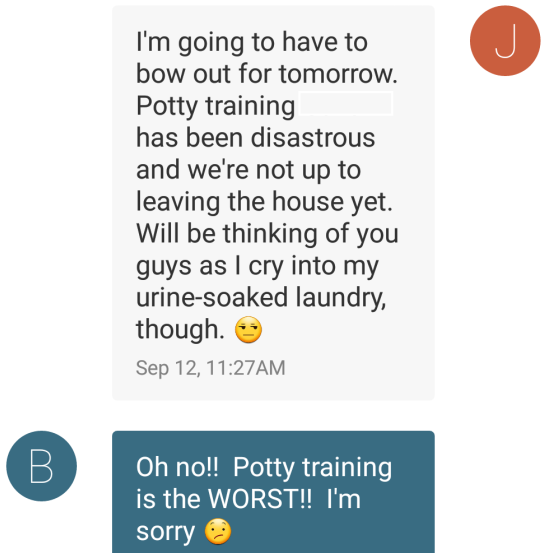
Potty Training Was a Little Rough This Time Around

My 2-year-old has been ready to potty train for a while.

He can tell when he has to pee.

He knows the whole sequence of pants down, go, pants up, dump, flush, and wash hands from watching his older brother.

He even occasionally uses the potty himself when the mood strikes him.

I thought since he was so close already, plus I'd already been through it with his 5 older siblings, potty training my 2-year-old was going to be one of the easiest things I'd ever done.

This just in: I'm an idiot.

We swear by a one-day potty bootcamp method, so we circled last Tuesday on the calendar and planned on having one more member of the Evans family enjoying complete control over his bodily functions by that evening.

What actually happened that evening is that he squatted over his dad's work shoes and peed in them.

'Badly' does not even begin to cover how boot camp went.

At one point I was actually thrilled when he peed on the hardwood floor instead of the carpet, so I guess you could say things weren't going well.  {posted @ Unremarkable Files}
I had even made plans for Thursday thinking he'd be trained. I was so naive.

I didn't realize this when he was in diapers, but the kid has a bladder that would make Fort Knox jealous.

When your potty training strategy depends on pumping him full of liquids so he gets to practice going to the bathroom all morning, that's a problem.

"Time to sit on the potty!" I'd say after he'd had almost a full quart (!) of juice, and he would but nothing happened.

After discussing how awesome the potty was over a mid-morning snack and then again over a floor puzzle of ocean creatures, I'd ask "Do you have to pee now?"

"No," he'd reply, casually flipping the page in a Sandra Boynton book with one ankle crossed over his other leg, giving off a faint GQ model vibe — if GQ models sat around in Lightning McQueen undies and had ridiculously large bellies from chugging 32 fluid ounces of white grape juice.

After two hours, he sneaked upstairs and peed on his sisters' carpet.

By the end of our one-day potty training boot camp, we only had a 50% success rate, and even then he wasn't initiating trips to the potty on his own.

Wednesday was even worse. Our success rate collapsed to 0%. At one point I realized I was actually thrilled when he peed on the hardwood floor instead of the carpet, A.K.A. things were not going well.

During his waking hours I sprayed 409 Pet Stain Remover on the rug and dreamed about running away to join the circus, and while he was napping I Googled "potty training hell" hoping that reading the misfortunes of those worse off would prevent me from actually running away to join the circus.

(The stories here and here helped, but I still felt pretty sorry for myself.)

I was so close to giving up that I didn't even mention potty training in my 7 Quick Takes Friday recap, even though I'd spent the better part of my week grossly exaggerating how cool mommy and daddy think the potty is (and watching my toddler urinate on the carpet regardless.)

Believe me, I'm not a quitter. But I seriously considered quitting this so-called potty training, which was beginning to look a lot like just me doing extra laundry.

At one point I was actually thrilled when he peed on the hardwood floor instead of the carpet, so I guess you could say things weren't going well.  {posted @ Unremarkable Files}
Yay for removing and washing all the couch cushions! Hip hip hooray!

What if we just went back to diapers? Pretended this whole thing never happened? Tom Cruise did it with the couch-jumping incident on Oprah and his career recovered. It was an option.

But no, I decided after WAY too much deliberation that the 2-year-old was ready and this thing was going to happen. He just didn't get a chance to really nail it during boot camp so we were going to start over and do it one more time.

And it went better.

A little.

On Friday, we took a successfully dry trip to the grocery store. We ran into an acquaintance there and during our conversation I gestured to my son and mentioned that "this was our first trip out of the house in underwear," not realizing until afterward I should've clarified that I did NOT actually mean for both of us.

On Saturday, we went to the library and didn't even need the three extra outfits I'd packed in my purse in a fit of paranoia beforehand.

Even though the lack of accidents was mostly due to his iron bladder rather than any particular commitment to depositing anything in a toilet, I rejoiced.

On Sunday he made it through two hours of nursery at church, and by Monday he was actually getting himself to the potty on his own when nature called, more often than not.

And on Tuesday, one week after beginning this adventure, he had his first accident-free day.

I'm not sure where I'm going with all this. 

Maybe I want you to know I can be stubborn, even more stubborn than a stubborn 2-year-old.

Maybe I want to encourage you not to give up when the crap is figuratively or literally hitting the fan, the floor, and your husband's work shoes.

Maybe I just want you to suffer through each painful detail as I had to do. I'm not above that.

Whatever it is, though, I think we're on the road to a fully-trained child.

And because the 2-year-old is our youngest, I'm left with a package of diapers that will probably never get used up (though he still wears them at night) and, ironically, really missing that ridiculously poofy diaper bum I used to see waddling through the house.

Click to Share:
Unremarkable Files
Read More »

Tuesday, May 15, 2018

It's Almost Magical When You Think About It

I love hearing the stories of people who converted to the Church of Jesus Christ of Latter-day Saints later in life.

Maybe it's because I'm a convert myself, but I think it's fascinating how no two people have the same story of where they were before. Some were active in another religion, some were seeking a spiritual home in a lot of different places, and others were completely uninterested in anything with the word "church" in it.

Some were introduced to the Church of Jesus Christ of Latter-day Saints by a friend, or answered the door when two missionaries knocked on it, or had a spiritual awakening when they found a Book of Mormon in a trash can (okay, I don't know anybody who that happened to but I'll bet it's happened to someone.)

No two stories are alike, but they all involve one thing: change.

What I love about the gospel is that it makes change possible, even in the least likely circumstances.

I just finished reading Jacob 5 in the Book of Mormon, a chapter that compares the House of Israel to an olive tree and the Lord to the master of the vineyard.

The master decides to take some of the main olive tree's branches and graft them all over the vineyard (i.e: scatter the tribes of Israel.) He also grafts wild branches into the original tree (i.e: adopt Gentiles.)

After a while he takes a servant around to see how the grafted branches are doing. They come to a tree in a far-flung corner that's doing great and the servant can't believe it. He asks the master why he even planted there in the first place because "it was the poorest spot in all the land of thy vineyard."

I like to picture the master kind of rolling his eyes as he points over to the left and answers, "Look hither, behold I have planted another branch of the tree also; and thou knowest that this spot of ground was poorer than the first. But, behold the tree." (Jacob 5: 21, 23; emphasis mine.) Which is, of course, bursting with fruit.

Sociology tells us that a whole lot in life is determined by the ground in which we're planted. We live out patterns experienced in childhood, which is why abused kids often grow up to be abusers and kids of alcoholic parents often struggle with substance abuse. We rarely leave the socioeconomic status we're born into. Mental illness, physical disease, and even character traits are products of both genetics and environment.

Statistically speaking, the ground where we're planted is important, but I'm not convinced it matters all that much to God.

In fact, sometimes He purposely takes an olive branch to the most barren, rocky, unfriendly place in the whole vineyard just to prove that when He's the gardener, miracles can happen.

Thank God for the miracle that change is possible, even in the most unlikely of circumstances.  {posted @ Unremarkable Files}

The Bible is full of unlikely events: younger brothers supplant older brothers for the birthright (Isaac and Ishmael, Jacob and Esau.) Joseph is sold into slavery in Egypt but somehow becomes one of the most powerful men in Egypt. Virgins and post-menopausal women have babies and people rise from the dead. That stuff just doesn't happen.

As a more contemporary example, I've seen firsthand the transformative power of the gospel. It can take someone who's been broken by life and give them hope. It can take someone who's been hardened by life and make them kind.

I'm continually amazed at how we all walk into church with different strengths and weaknesses, yet the same gospel somehow works like sandpaper on our souls, smoothing out the rough edges that on no two people are in the exact same places. How can something humble the rich and, at the very same time, lift up the poor?

When I joined the church at age 18, changes to my life followed. I cleaned up my language and the way I dressed and the music I listened to. My priorities shifted. Some of the changes I made in my life felt major, but at the same time I felt like I was closer than ever to the person I'd always been on the inside.

I can hardly explain what I mean by that, so maybe it's just easier to say that the gospel is like magic.

It changes us but transforms us into a truer version of ourselves than we ever were before. It's the same for everyone but somehow tempers each of us just a little in the way we need, even though no one's needs are the same! It assures us that even if we're planted in the very worst soil in all the vineyard, that doesn't preclude some very amazing growth.

Which is good because I still have a lot of growing to do. I keep opening up my scriptures and getting on my knees in prayer asking for help with old habits and character flaws that at times seem too deeply ingrained to change.

Honestly, if it weren't for the powerful nature of the gospel I'd be tempted to throw my hands in the air and say "I give up, it's too hard."

And it would be, if it weren't for God's lengthy track record of unlikely successes and beating the odds through His amazing love.

Click to Share:
Unremarkable Files
Read More »

Monday, April 23, 2018

This Is What Happened When I Let My Daughter Ride the Subway Alone

This post contains my affiliate link. Translation: if you buy something using a link here, I'll receive a commission for referring you.

Recently I saw a video called "Things We Still Ask Our Moms." It was supposed to be funny, but I can't say for sure because I passed out at the sight of grown women calling home to ask their mothers how to do laundry, make a dentist appointment, and even soften a stick of butter. (I was feeling physical pain by the 20-second mark, so be careful and watch at your own risk.)

Hopefully that video isn't representative of all young adults today, but it's a fact that more and more kids are growing up and leaving the house without the basic skills grown-ups need.

Some mothers do their teenagers' laundry and clean their rooms for them; one mom I knew always cut up her 16-year-old daughter's pancakes. (When she asked "What are you going to do when you go to a restaurant on a date?" her daughter answered, "I'll order something I don't need to cut.")

I can't make this stuff up, people.

Raising my kids to become independent, self-sufficient, hard-working adults is kind of an obsession for me. When I consider the sheer volume of things I want my kids to be able to do for themselves by age 18 and how fast their time at home really goes, I feel the pressure. (My favorite book on the subject is The Parenting Breakthrough, which details the value of kids who work and lists age-appropriate tasks so that, you know, your 20-year-old doesn't call home one day asking how to boil an egg.)

In addition to "hard skills" like washing dishes and sweeping floors, I also think a lot about how I can help my kids develop "soft skills." Specifically, I want them to have the confidence to face difficult situations instead of avoiding them, and the resourcefulness to solve problems instead of running away from them.

Which is why I did something that made other parents raise an eyebrow: every day last week, I dropped my 13-year-old daughter off at the subway station with my phone, $20, a bottle of water, and a wave good-bye.

You see, she'd enrolled in a painting class at an art museum in the city about an hour from here. She's a fantastic artist and would of course gain some useful art skills in class, but truthfully I was way more excited for the life skills she was going to learn from getting there on her own.

Questions people asked ranged from "She's how old?" to "She can do that?" to "Are you comfortable with that?"  {posted @ Unremarkable Files}

When I told other parents that my daughter was riding the subway to the class herself, their reactions varied from "Really? How old is did you say she was?" to "Wow, she can do that?"

One person even offered to go with her, but I had to explain that it wasn't a schedule conflict that prevented me from depositing her at the front door of the museum every day  I just wanted her to do it herself.

Another question I got asked was: "Are you comfortable with that?"

Of the dozen or so times I've ridden the subway here, I've never felt unsafe. Our subway system doesn't have a reputation for excessive crime. Realistically speaking, the worst-case scenario was that she'd miss her stop or get on the wrong train when she transferred lines, and be late for class.

Since we're not avid subway-riders, I did go on the train with my daughter the first day. I told her I was just going along to show her how to read the subway maps and the next day, I'd just drop her off at the station and pick her back up in 5 hours.

So what happened when I let her ride the subway on her own?

Absolutely nothing.

Well, let me rephrase that. Absolutely nothing bad happened. She wasn't hurt, taken advantage of, kidnapped, or mugged.

But plenty of good things happened.

The first good thing that happened was that she gained confidence in herself. By the end of the week she was hopping out of the car knowing she could get wherever she needed to go. Her world was bigger than it had been at the beginning.

The second good thing was that she learned to problem-solve. When she tried to buy her ticket on her first solo day, the ticket machine wouldn't accept her money, and there was no attendant at the information booth to help her.

I was already halfway home when she called with her predicament and I told her, "Well, read the instructions on the machine and good luck figuring it out. If there's no attendant and you still can't get it to work, you'll have to ask some random person walking by for help."

So she did ask a random person for help, and a third good thing happened: she saw for herself that "stranger danger" is a dumb concept. Most strangers are not dangerous, evil, or psychotic. The majority of them aren't skulking around looking for opportunities to steal children. They're just nice people trying to catch their train. Be smart and obviously don't go down a dark alleyway with someone you don't know, but there's no reason to avoid interacting with a stranger at all costs.

It turned out that the ticket machine was broken, so the helpful stranger used his own ticket to pay my daughter's fare and let her into the subway. (She felt bad that he wouldn't let her pay him back, so I suggested she could pay it forward and be someone else's helpful subway stranger someday.)

And then a fourth good thing happened. There aren't ticket machines at every stop, meaning that she had to figure out how she was going to get a ticket for her return trip. She used the phone to look up which locations sold tickets, found one, and made an unscheduled stop to go up to street level and figure out how to buy one at the ticket kiosk before transferring lines and continuing on her way to art class. Then she called me to let me know she solved the problem.

Questions people asked ranged from "She's how old?" to "She can do that?" to "Are you comfortable with that?"  {posted @ Unremarkable Files}
A pastel drawing by my daughter, circa 2017. Like I said, she's an amazing artist.

The most valuable thing my 13-year-old learned at art class last week had less to do with color and composition and everything to do with self-confidence.

Unlike color theory, confidence isn't just a piece of information that can be taught. In order for her to internalize how capable she is, she's got to have opportunities to see that it's true.

So I loved sending my daughter off on the subway alone, and I would do it again. Because now the next time things go wrong and she doesn't know what to do, I think she'll be able to reach back to this moment and grab on to it, reminding herself, "It's okay. I don't need to feel scared, intimidated, inadequate, or defeated. I can figure this out."

And then she will.

Raising independent kids is a huge parenting goal of mine, which is why I let my daughter ride the subway alone. Other parents raised their eyebrows and called it ‘free range parenting,’ but I loved the life skills she gained from the trip and you can read all about why in this article. #independentkids #lifeskills #children #freerange #parenting #unremarkablefiles

Click to Share:
Unremarkable Files
Read More »